

Ensuring Business Continuity Through Spooler Job Replication
Most, if not all, of NonStop customers have a DR (Disaster Recovery) system, as well as a plan to ensure business continuity of their mission-critical applications in the event of a disaster. A company's goal is to be able to resume business operation as quickly as possible with minimum interruption. The main focus of the daily operation plan is to ensure applications and third-party packages are up-to-date on the DR system, and that the database and files are synchronized regularly from Production to DR.
The Challenge: How About Spooler Jobs?
Many NonStop installations have hundreds, and maybe even thousands, of daily jobs in their spoolers. Many of them are reports from batch applications, online transaction logs, and other important output data needed for critical business analysis. While spooler jobs are not necessarily critical to online transaction processing, much of the report data may be crucial to a company's efficient daily operations.
In the event of a disaster requiring a failover to the DR system, the absence of these critical reports can impact business continuity. Organizations need a reliable method to ensure that spooler jobs are replicated and available on the DR system, ready to be brought online quickly when needed.
The Solution: How to Replicate Spooler Jobs
One simple and elegant method to replicate spooler jobs from Production to DR system easily is to use TIC's Tele2000 product. Tele2000 provides an architecture framework that extracts spooler jobs, stores them in disk files, and delivers them to external systems via email, FTP, or Web.
TeleFTP: The Key Component
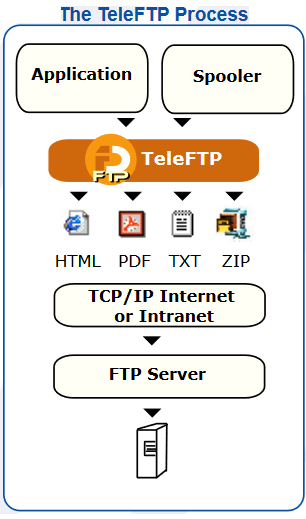
The FTP module TeleFTP automates the transmission of NonStop Server files and Spooler reports to FTP Servers. Besides FTP Client capability, Tele2000 also includes options to convert data to different formats prior to transmission, including: PDF, HTML, and ZIP. TeleFTP is built on Tele2000 architecture, which offers flexibility, high performance, and scalability.
The TeleFTP workflow operates as follows:
- Tele2000 can be configured to monitor spooler jobs in specific collectors and LOCs (Line of Credit).
- Data content of those spooler jobs is extracted and stored into disk files.
- Each disk file is then sent by the TeleFTP module via FTP protocol directly into the DR's target Spoolers, including preserving the LOC and DEST information.
- NonStop system's FTP server allows spoolers to be a target destination.
- DR Spoolers will then have a duplicate of all the critical spooler jobs in Production System.
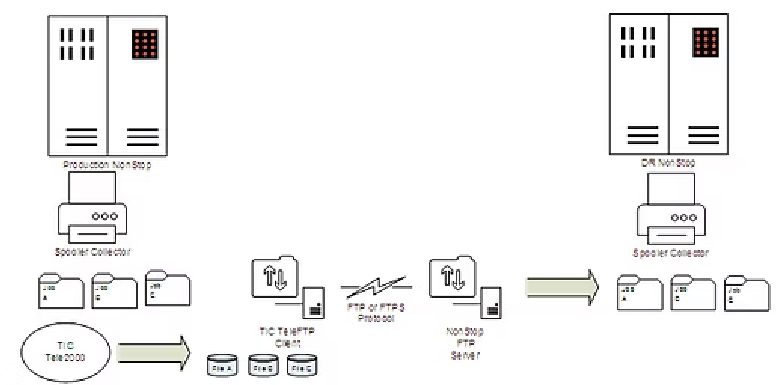
Using TeleFTP for Disaster Recovery provides a simple and elegant way to replicate spooler jobs to your DR system. This automated approach ensures that when disaster strikes, your DR system already has the critical reports and data needed to maintain business continuity with minimal delay.
Beyond Disaster Recovery
As depicted above, using TeleFTP is a simple and elegant way to replicate Spooler Jobs to a DR system. Of course, TeleFTP is not limited to DR use; in fact, TeleFTP users are relying on its extensive features for all of their FTP transmissions from NonStop to external systems, daily.
TeleFTP's capabilities extend beyond disaster recovery scenarios. Many organizations use TeleFTP for:
- Regular report distribution to stakeholders across multiple systems
- Integration with external applications and partners
- Automated data formatting and transformation
- Secure transmission of critical business information
Key Features of Tele2000 and TeleFTP
- Automatic Monitoring: Monitor specific collectors and LOCs for spooler jobs
- Format Conversion: Convert data to PDF, HTML, ZIP, and other formats
- FTP Transmission: Reliable, automated FTP transmission to external systems
- Metadata Preservation: Maintains LOC and DEST information during transfer
- Scalability: Built on robust architecture to handle high-volume operations
- Flexibility: Configurable for various deployment scenarios
Conclusion
Disaster recovery is not just about having a backup system in place—it's about ensuring that critical business data and reports are readily available when you need them most. By implementing TeleFTP for automatic spooler job replication, organizations can:
- Reduce manual intervention during disaster recovery operations
- Ensure critical reports are available on the DR system immediately
- Minimize business interruption and recovery time
- Maintain data integrity and LOC/DEST information consistency
- Leverage proven, reliable NonStop integration technology
With TIC Software's Tele2000 and TeleFTP products, you can answer the question "How quickly can you bring up critical reports on your DR system?" with confidence: instantly, with all critical data intact and ready for business operations.
